Welcome to Jiangsu Yigao Medical


 ENG
ENG

 English
 Español
Welcome to Jiangsu Yigao Medical

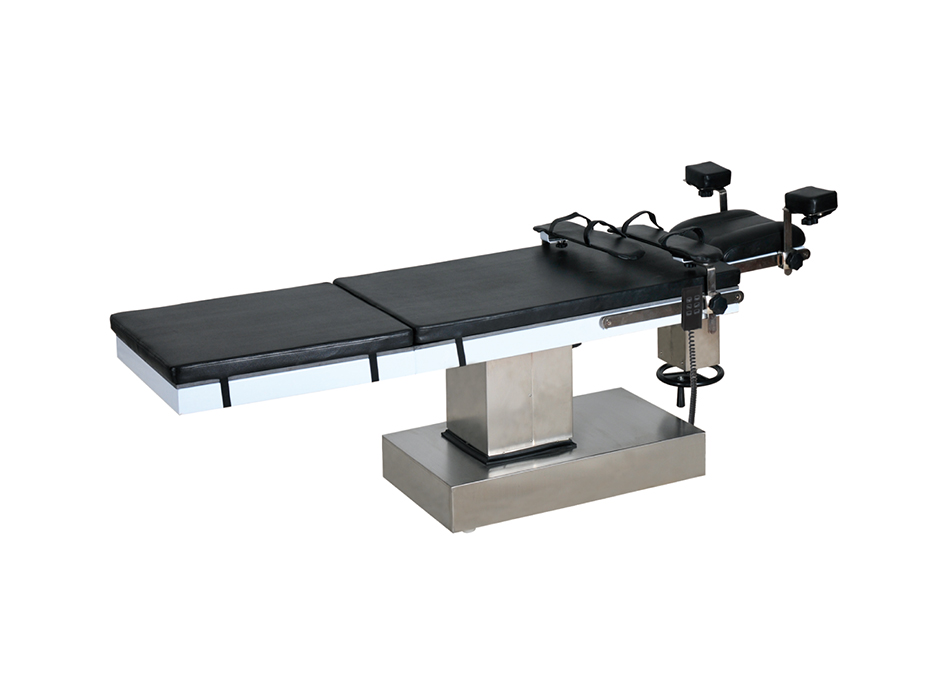
If you have ever watched a surgical team raise, tilt and fold a table without anyone reaching for a crank, you have already watched the answer in action. An operating table is a positioning machine: electric motors and hydraulic cylinders, coordinated by a control board, moving a segmented tabletop that has to hold completely still the moment the surgeon begins.
One small clarification before we go further. A fair number of people searching for a "PAL operating table" are really looking for the crafting station of the same name in the game Palworld, which is a virtual device with virtual rules. This article is about the real thing: the table a patient lies on in theatre, and the mechanics that make it move.
Whatever the price point, almost every surgical table is built from the same four layers. Once you can picture them, the rest of the machine becomes much easier to follow.
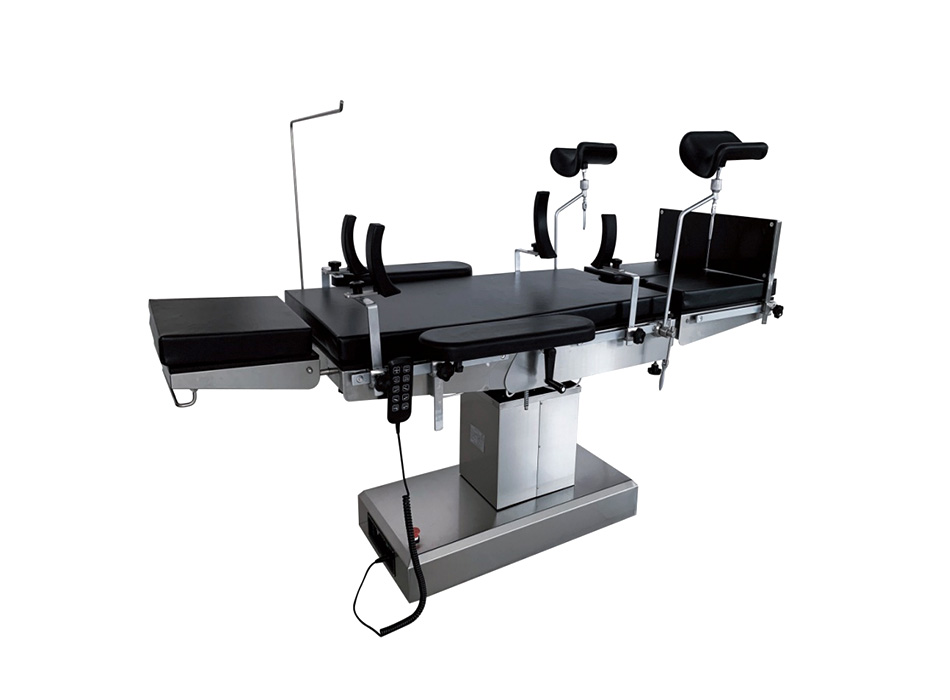
Accessories such as arm boards, leg holders, headrests and traction frames clamp onto the side rails, which is why most manufacturers keep the rail profile standard.
There are three drive families in common use, and which one you are standing next to changes almost everything about how the table behaves day to day.
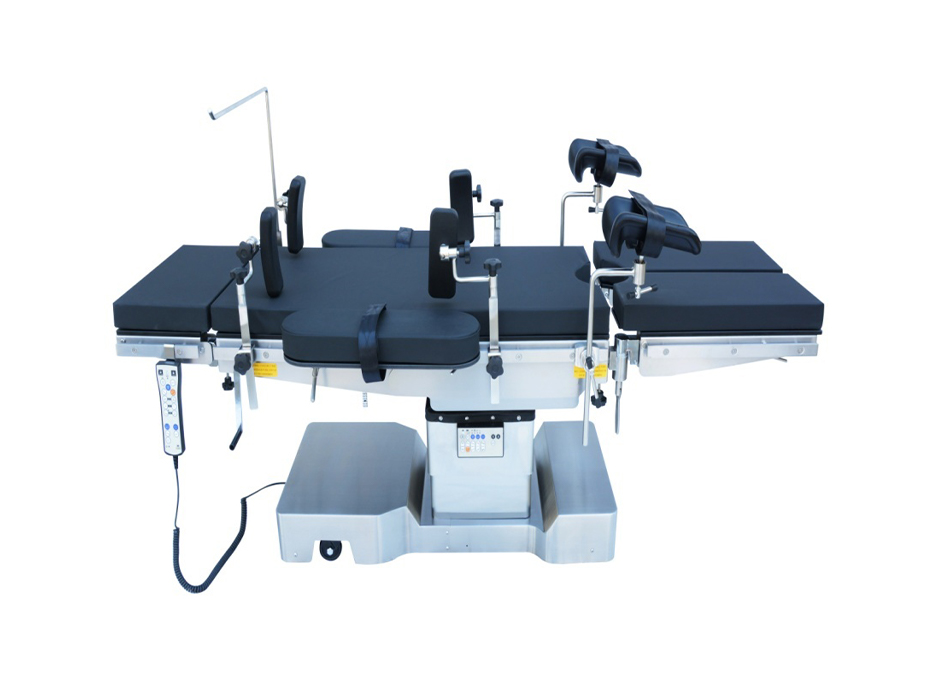
In a fully electric table, each function has its own linear actuator: a small motor driving a screw or gearbox. Press a button and the actuator extends, pushing the corresponding tabletop section. Because each movement is driven separately, the motion is quiet, repeatable and easy to fine-tune, and the table can be levelled or tilted by very small degrees. Electric models also tend to have the cleanest profiles, since there is no oil reservoir or pump pedal to route around. A typical general-surgery unit such as our YGD02 electric operating table pairs three or four actuators with a battery pack and a wired hand control, which is the practical core of the design.
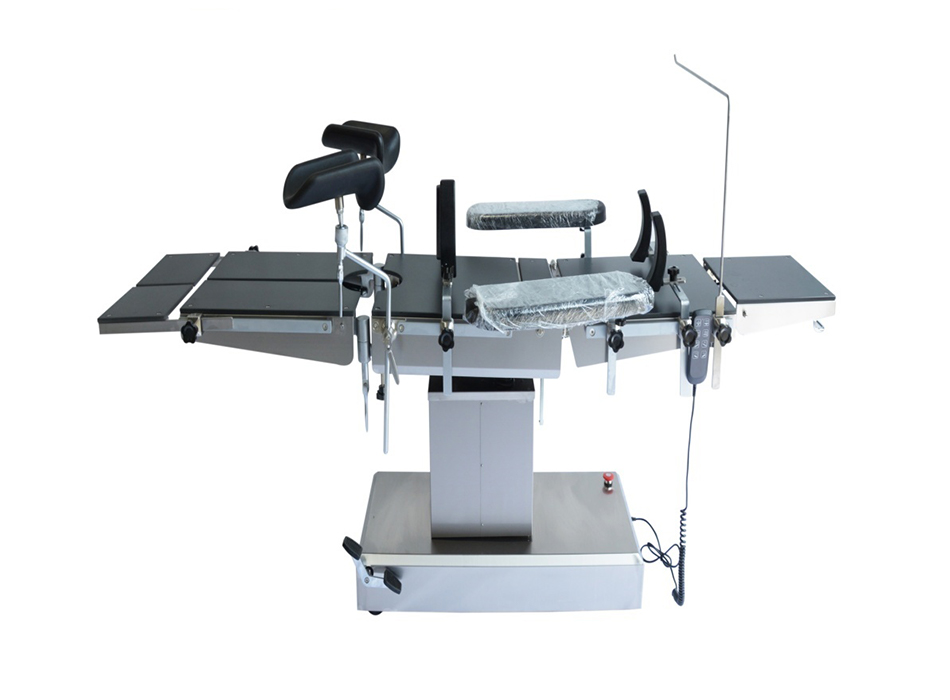 YGD02 Electric Surgical Operating TableA four-function electric surgical table with battery backup and detachable leg boards, suitable for general surgery and multiple specialties.View Product →
Hydraulic tables use a pump, a reservoir, control valves and one or more cylinders. The pump pushes oil into the cylinder, the piston rod rises, and the tabletop goes up with it. Because oil is effectively incompressible and the cylinder bore can be large, hydraulics produce a great deal of force from a compact package, which is why they remain so common on tables that need high load capacity or very low positioning.
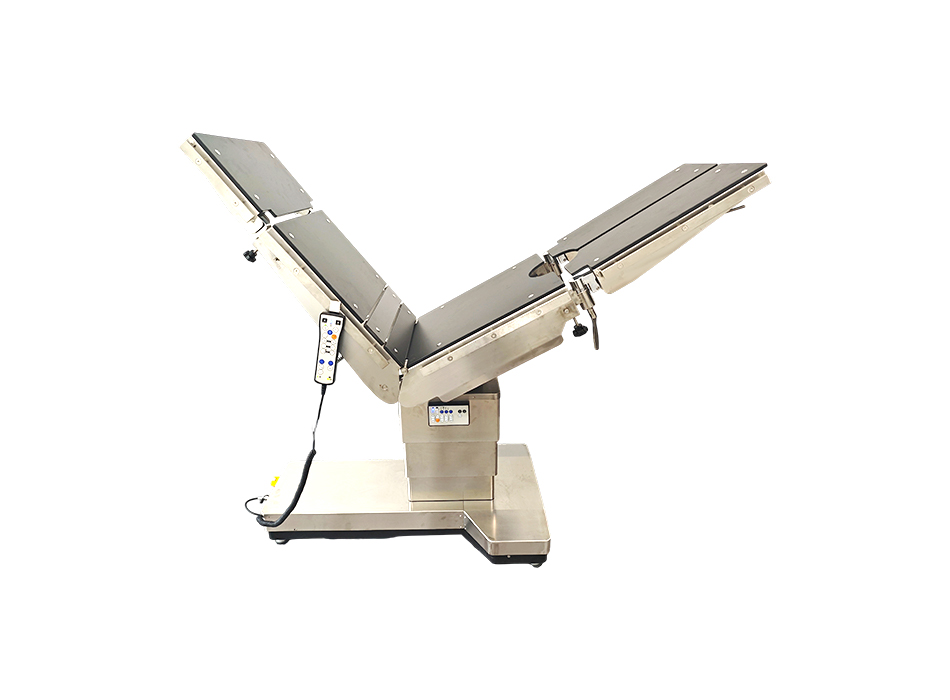
An electrohydraulic table simply replaces the foot pedal with an electric motor that drives the pump. The clinician presses a button, the motor spins the pump, and the cylinder moves. That combination gives you the smoothness and lifting power of hydraulics with the convenience of push-button control, which is why models like the YGDH04 electrohydraulic operating table are such a practical middle ground for busy theatres.
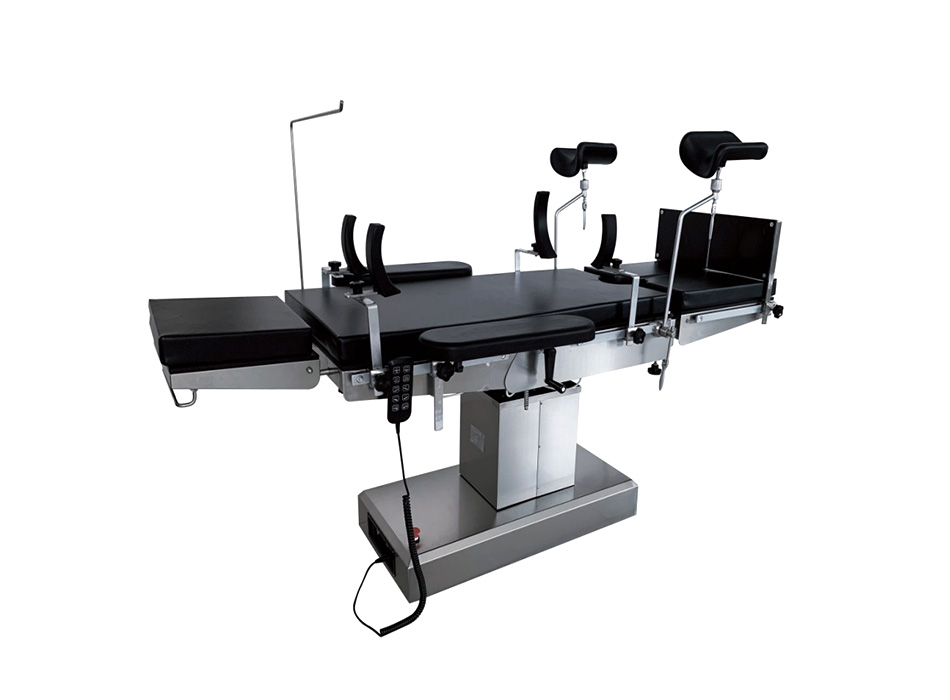 YGDH04G Electrohydraulic Surgical Operating TableAn electrohydraulic table with electric push-button control for lifting, tilting and backboard adjustment, plus longitudinal tabletop movement for C-arm use.View Product →
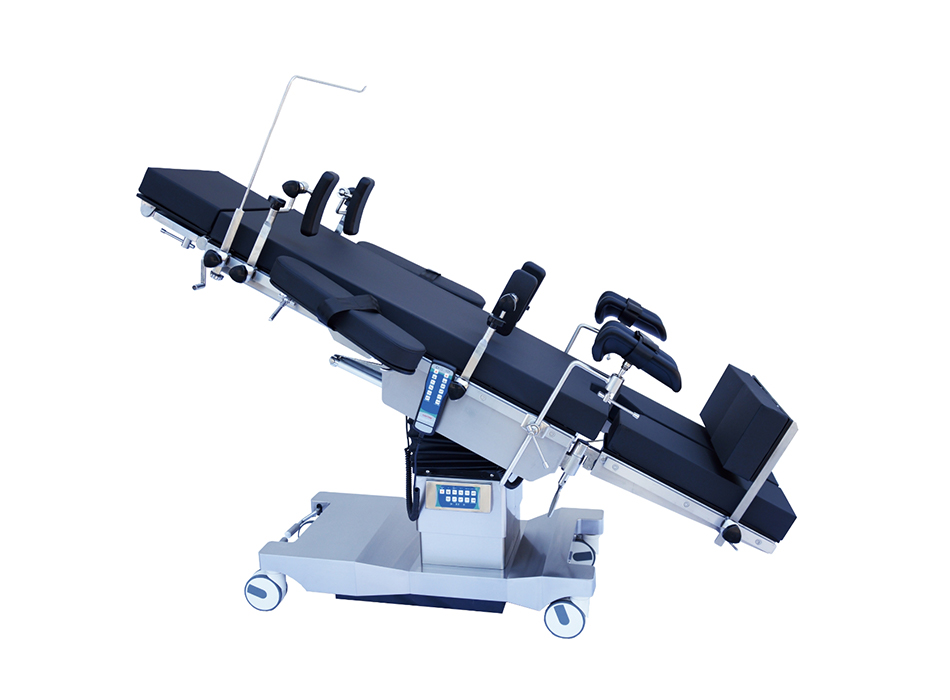
A manual table still relies on hydraulics for height, but the pressure comes from a foot pump rather than a motor, while back, leg and tilt sections are adjusted with cranks, gears or gas springs. The trade-off is straightforward: slower to reposition, but no electronics to fail, no battery to maintain and far less to go wrong in a setting where power quality is unpredictable. Fully equipped manual hydraulic tables such as the YGS3008B multifunction model are still a dependable choice for clinics, field hospitals and secondary theatres.
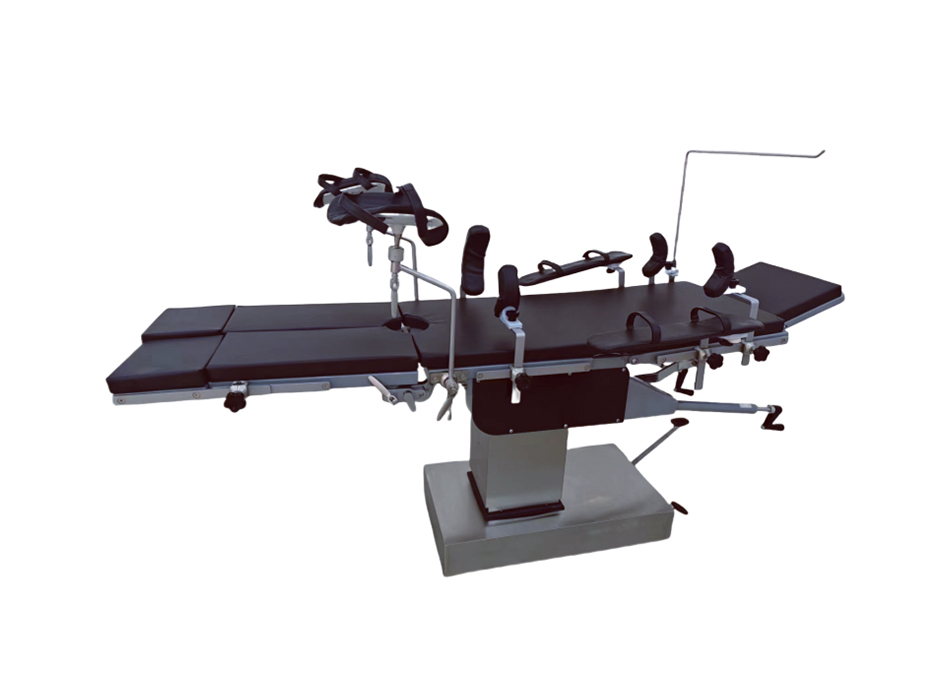 YGS3008B Multifunction Hydraulic Operating TableA manual hydraulic table with foot-pump lifting and hand-crank adjustments, suited to clinics, field hospitals and secondary theatres where simplicity matters.View Product →
It helps to separate the table into the parts that support the patient and the parts that make them move. The table below maps the two together.
| Assembly | What it does | Typical drive |
|---|---|---|
| Tabletop sections | Supports the patient; head, back, seat and leg plates move independently | Electric actuator or manual latch |
| Lifting column | Raises and lowers the entire tabletop through its full travel range | Hydraulic cylinder or electric actuator |
| Base and casters | Keeps the table stable and allows it to be moved between rooms | Retractable casters with floor locks |
| Control system | Turns button presses into precise movement and blocks unsafe commands | Wired hand control, infrared remote or column panel |
| Battery pack | Keeps the table moving during a power interruption | Sealed rechargeable battery |
| Side rails and accessories | Hold arm boards, leg holders, headrests and traction frames | Standard clamp-on rail profile |
People often assume the hand control talks directly to the motor. In practice there is a short chain of steps in between, and each one exists for a reason.
That is why a good table feels predictable: the control board is doing the thinking, and the operator only has to point it in the right direction.
Although the button layout differs between models, the vocabulary of movement is fairly consistent across the industry.
A table that drifts during surgery is dangerous, so stability is engineered in at several levels. Hydraulic circuits use check valves that lock the cylinder unless the release valve is deliberately opened. Electric actuators are typically self-locking, meaning the screw holds position when the motor is idle. The base carries a floor lock or braking casters that lift the wheels clear of the ground, and the column is designed with a wide footprint to resist tipping when a heavy patient is placed at the extreme end of a tilted tabletop.
Good tables also include a manual emergency release. If the power fails completely, the surgical team can still bring the tabletop back to a flat, low position by hand rather than being stuck in a tilted attitude.
The working surfaces are almost always stainless steel, chosen for corrosion resistance and for surviving repeated disinfection. Where intraoperative X-ray or C-arm imaging is expected, the tabletop may use a radiolucent carbon fibre section or provide a cassette tunnel so film can slide underneath the patient.
Cleanability is a design feature in its own right. Smooth surfaces, sealed seams and rounded corners stop blood and cleaning fluid from collecting in crevices, and hand controls are usually rated for splashing so they can be wiped down between cases without being unplugged.
If you are selecting a table, start from the workload rather than the brochure. A high-volume orthopaedic or cardiac theatre benefits from electrohydraulic lifting and a wide range of powered positions. A small clinic that performs occasional procedures may be better served by a manual hydraulic table that is simple to maintain.
Maintenance is mostly about the drive system. Hydraulic tables need their oil level and seals checked, and any slow sinking under load usually points to a worn valve or seal rather than a controller fault. Electric and electrohydraulic tables live or die by their battery, so keeping the pack charged and replacing it on schedule prevents most mid-case surprises. Casters, floor locks and hand control cables are the other common wear points, and all three are inexpensive to service compared with a failed column. If you want a closer comparison of the two main drive types before deciding, our guide on electric versus hydraulic operating tables walks through the trade-offs in more detail.
So how does an operating table work? A command travels from the hand control to a control board, the board releases power to a motor or hydraulic pump, and a cylinder or actuator moves a specific section of the tabletop. Everything else, the locks, the feedback sensors, the battery backup and the materials, exists to make that movement smooth, repeatable and safe.
If you are planning a theatre, replacing an ageing table or simply trying to understand what your current one is doing, our team is happy to walk through the options with you. You can talk to our team about your clinical requirements, and we will point you towards the drive system and configuration that actually fits the work you do.
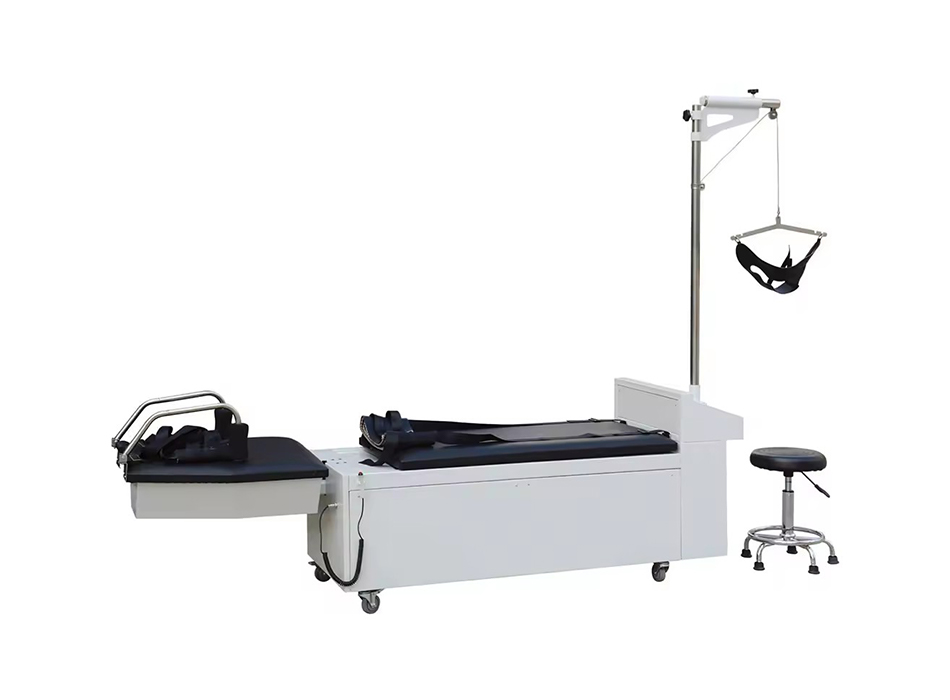
If you are interested in our products, please consult us
Copyright © 2026 Jiangsu Yigao Medical Equipment Technology Co., Ltd.

Custom Electric Medical Bed Manufacturers
The information provided on this website is intended for use only in countries and jurisdictions outside of the People's Republic of China.