Welcome to Jiangsu Yigao Medical


 ENG
ENG

 English
 Español
Welcome to Jiangsu Yigao Medical

In emergency medical services (EMS), the safe and efficient transportation of patients is a critical aspect of care. One of the most important pieces of equipment used in this process is the patient stretcher. While there are various types of stretchers available, manual patient stretchers remain a popular and reliable choice in ambulance transport due to their affordability, ease of use, and adaptability to different emergency situations.
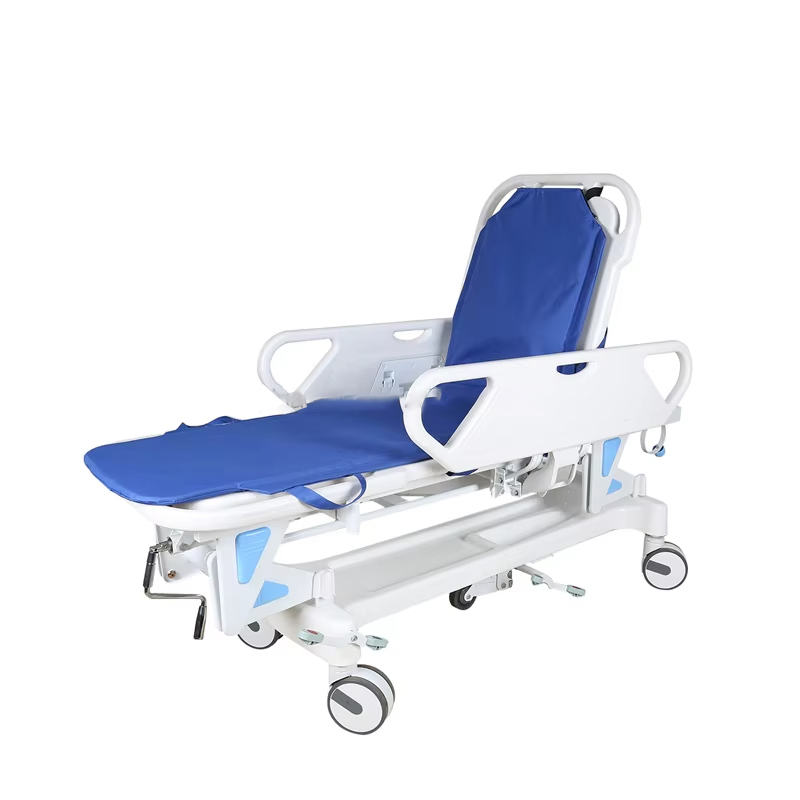
A manual patient stretcher is a piece of medical equipment used to transport patients, typically in emergency medical situations. Unlike electric stretchers, which are powered by motors to raise or lower the stretcher, manual stretchers rely on human strength to adjust their height and position. These stretchers are equipped with wheels for easy mobility, and they often feature adjustable backrests and footrests for patient comfort and positioning.
Manual patient stretchers are commonly used in ambulances, hospitals, clinics, and even in field medical situations, where rapid patient transport is necessary. Their simple design and mechanical functionality make them a reliable and cost-effective option for healthcare providers.
One of the primary reasons manual patient stretchers are so widely used in ambulances is their cost-effectiveness. Compared to electric stretchers, manual stretchers are significantly less expensive, both in terms of initial purchase price and ongoing maintenance costs.
Electric stretchers, while providing the convenience of powered adjustments, require regular maintenance, repair costs, and access to electrical power, which can be challenging in certain environments. Manual stretchers, on the other hand, are less prone to mechanical failure, have fewer components that require servicing, and don’t rely on electricity, making them a more budget-friendly option for both emergency medical services and hospitals with limited resources.
For ambulance services, especially those in areas with tight budgets or rural locations, the affordability of manual stretchers makes them an attractive choice. They are widely available and do not require specialized maintenance, making them a practical solution for ensuring safe and efficient patient transport.
Manual patient stretchers are designed to be simple and intuitive to use. With minimal mechanical parts and no need for electrical components, these stretchers can be operated with ease by EMS professionals, even under pressure during emergencies.
The manual adjustments—such as raising or lowering the stretcher height and adjusting the backrest—can be done with the use of a simple lever or hand-operated mechanism, which allows for quick changes to suit the patient's needs. This ease of operation is critical during emergency situations when time is of the essence.
Unlike electric stretchers, which may require power sources or involve more complicated controls, manual stretchers can be quickly maneuvered and adjusted, ensuring that EMS teams can respond swiftly to the patient’s condition without delay. The ability to adjust the stretcher height or position manually allows EMS personnel to control the patient’s comfort and safety during transport, which is especially important for patients with injuries or medical conditions that require specific positioning.
Manual patient stretchers are lightweight and easy to maneuver, making them ideal for environments where space is limited or where quick and efficient movement is required. Ambulances often operate in crowded, high-pressure environments, and manual stretchers provide the flexibility needed to navigate these spaces efficiently.
Because they are not dependent on electrical power, manual stretchers can be used in a wide range of settings, including rural or remote areas where access to electricity may be limited. They are also suitable for use in field medical operations or during natural disasters when power sources may be unavailable.
The portability of manual stretchers makes them an excellent choice for emergency medical services operating in diverse and challenging environments. They are easy to load into and out of vehicles and can be moved quickly within tight spaces, providing the versatility required for patient care in a variety of situations.
Manual patient stretchers are known for their durability and long lifespan. Built with robust materials such as steel, aluminum, or high-strength plastic, these stretchers can withstand the wear and tear of frequent use in demanding environments.
The absence of electrical components in manual stretchers reduces the likelihood of mechanical failure. This makes them more resilient to damage that might occur in high-stress situations. While electric stretchers can sometimes be prone to issues such as power loss or motor malfunction, manual stretchers rely solely on human operation, which makes them more reliable in emergency settings where malfunctioning equipment can have serious consequences.
EMS teams often use manual stretchers for extended periods without requiring frequent repairs or replacements, making them a cost-effective long-term investment. Their ability to withstand tough conditions while continuing to perform well is one of the reasons they remain a go-to choice for ambulance transport.
Although manual stretchers lack the powered features of electric stretchers, they still offer significant benefits when it comes to patient comfort and safety. Many manual stretchers are designed with adjustable backrests, footrests, and side rails to accommodate the patient’s needs during transport.
The ability to adjust the backrest and position the patient can provide comfort and support, particularly for patients experiencing trauma, injury, or medical conditions like heart attacks or respiratory distress. The manual adjustment system allows EMS personnel to fine-tune the stretcher’s position, offering a customizable level of comfort while minimizing the risk of discomfort or injury during the ride to the hospital.
Moreover, manual patient stretchers are often equipped with safety features such as locking mechanisms, secure straps, and protective side rails that keep the patient securely in place during transport. These features ensure that the patient remains safe and comfortable while reducing the likelihood of falls or movement that could worsen their condition.
In emergency medical services, reliability is paramount. The simplicity of manual patient stretchers makes them incredibly dependable in critical situations. EMS professionals can quickly deploy these stretchers without the need for advanced training or technical knowledge, which can be particularly valuable in high-stress environments where every second counts.
While electric stretchers may offer more convenience, they can also introduce complexity, especially if electrical issues arise. Manual stretchers, by contrast, operate independently of electrical systems, making them less prone to failure in situations where other equipment might malfunction.
In critical situations, when paramedics are dealing with multiple patients or need to transport individuals rapidly, the reliable design of manual stretchers allows them to focus on patient care rather than worrying about the equipment. This added peace of mind makes manual stretchers a trustworthy choice for both EMS professionals and healthcare facilities.
Manual stretchers are also relatively easy and inexpensive to maintain. Since they do not have the complex electrical systems that require frequent servicing, their maintenance typically involves simple tasks such as cleaning, checking for mechanical issues, and replacing worn-out parts like wheels or handles.
This lower cost of ownership is especially important for ambulance services operating within tight budgets. Regular servicing of manual stretchers ensures that they remain in top condition, providing reliable patient transport without the added costs associated with power-driven systems.
As emergency medical services strive to be more eco-conscious, the manual stretcher offers an environmentally friendly alternative to electric models. Since manual stretchers do not rely on batteries or electricity, they have a much lower environmental footprint, making them a more sustainable option for EMS operations.
With growing concerns about energy consumption and the environmental impact of medical equipment, manual patient stretchers provide a green solution without sacrificing performance or safety.
If you are interested in our products, please consult us
Copyright © 2026 Jiangsu Yigao Medical Equipment Technology Co., Ltd.

Custom Electric Medical Bed Manufacturers
The information provided on this website is intended for use only in countries and jurisdictions outside of the People's Republic of China.