Welcome to Jiangsu Yigao Medical


 ENG
ENG

 English
 Español
Welcome to Jiangsu Yigao Medical

Traction uses a controlled pulling force, balanced against an equal counterforce, to realign bone, take pressure off a joint or nerve, or hold an injured limb still while it heals. It's one of the oldest mechanical treatments in medicine, and while surgical fixation has replaced it for most fracture care, it's still standard practice for spinal decompression therapy, temporary fracture stabilization before surgery, and certain pediatric and pre-operative situations where a pulling force does the job better than any alternative.
Medical traction is the application of a steady or intermittent pulling force to a bone, joint, or the spine, paired with counter-traction in the opposite direction. That combination of force and counterforce is what separates traction from simple stretching — the counterforce (patient body weight, an angled bed, or a second pulley system) is what keeps the pull from just dragging the whole patient across the bed.
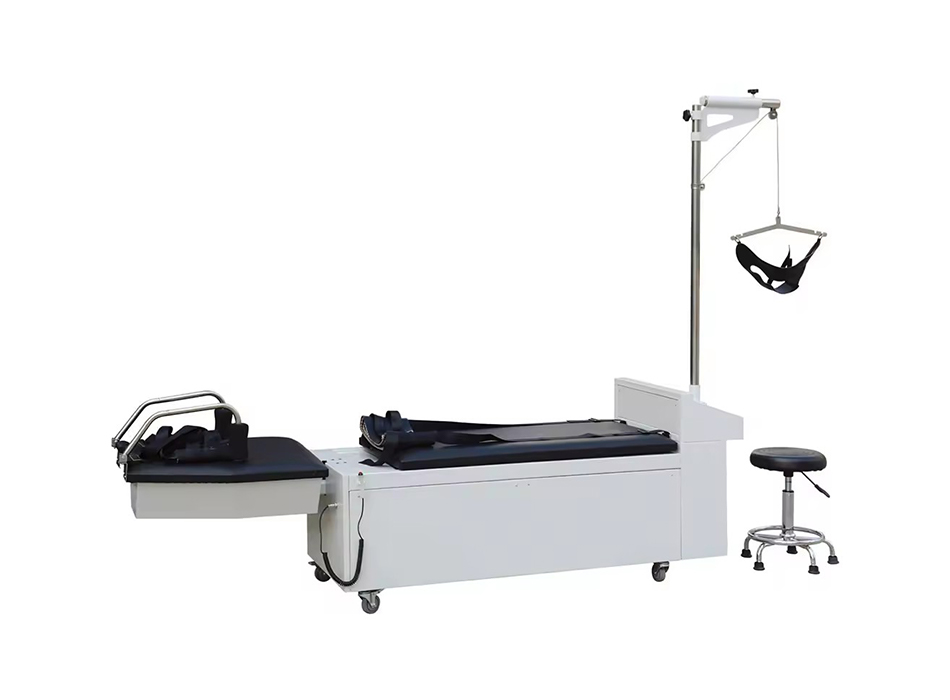
Every traction setup, from a home cervical device to a hospital traction bed with a Balkan frame, relies on the same physical principle: a pulling force applied along a controlled line, with an opposing force holding the rest of the body in place so the pull acts only where it's intended to.
Traction is generally intended to distract, or pull apart, joint surfaces or vertebral bodies; widen the space where a nerve exits the spine; stretch tightened muscles around an injury; or hold fracture fragments in alignment while healing progresses or surgery is scheduled. Which of those goals applies depends heavily on whether the traction is applied through the skin or directly through bone.
The two categories differ in how the pulling force reaches the bone, and that difference determines how much weight can safely be applied and for how long.
| Factor | Skin traction | Skeletal traction |
|---|---|---|
| How force is applied | Adhesive strips, foam boots, or straps on the skin | Pins or wires surgically inserted through bone |
| Typical weight limit | Usually 4–5 kg in adults | Can safely reach 20–25 kg |
| Typical duration | Short-term: pain relief, pre-op alignment | Longer term, until surgery or healing progresses |
| Invasiveness | Non-invasive | Invasive — carries infection and nerve/vessel injury risk |
| Common examples | Buck's traction, Russell traction, halter cervical traction | Gardner-Wells tongs, Steinmann pin traction, halo traction |
A traction frame is the structural scaffold — usually an overhead Balkan frame with vertical uprights clamped to the bed — that holds every pulley, rope, and splint in the exact geometric position the treatment requires. Without correct frame assembly, even the right traction weight becomes ineffective or actively harmful, because the line of pull no longer matches the injury.
Traction shows up in a narrower set of situations today than it did decades ago, since internal and external fixation devices now handle most definitive fracture treatment. It remains genuinely useful in specific, well-defined roles.
| Clinical context | How traction is used |
|---|---|
| Pre-surgical fracture stabilization | Skeletal or skin traction holds a femoral or hip fracture aligned and reduces muscle spasm while surgery is scheduled |
| Cervical spine conditions | Creates space between neck vertebrae to reduce pressure on a pinched nerve root or bulging disc |
| Cervical spine trauma | Skull tongs (Gardner-Wells or Crutchfield) or halo traction stabilize an unstable neck injury |
| Pediatric hip and femur conditions | Bryant's traction and similar setups are used in infants and young children where surgical options are more limited |
| Correcting fixed deformities | Gradual traction over time can correct minor fixed flexion deformities at the hip or elsewhere |
The evidence for lumbar (lower back) traction has weakened over time. Several national clinical guidelines no longer recommend it as a routine treatment for low back pain, even though it's still sometimes used. Cervical traction has a more established, though still mixed, evidence base, and is generally only started under a healthcare provider's guidance after an in-person evaluation.
This article explains how traction works and where it's applied — it isn't a recommendation for or against traction in any individual case. Any decision to start, adjust, or stop traction should be made with the treating physician or physical therapist.
Most traction complications trace back to a handful of principles being skipped, not to the treatment itself failing. These are the checks that clinical staff repeat throughout the course of treatment.
Traction works by pairing a controlled pulling force with a counterforce, applied either through the skin or directly through bone, to realign a fracture, decompress a spinal segment, or hold an injury still. A traction frame and traction bed are the physical scaffold — pulleys, splints, and a firm mattress — that keep that force running in exactly the right direction.
Skin traction handles lighter, shorter-term needs; skeletal traction handles heavier, longer-duration cases; and both depend entirely on correct setup and regular monitoring to stay effective and safe — which is why traction is applied and adjusted only under direct clinical supervision, never self-managed beyond a provider-approved home device.
If you are interested in our products, please consult us
Copyright © 2026 Jiangsu Yigao Medical Equipment Technology Co., Ltd.

Custom Electric Medical Bed Manufacturers
The information provided on this website is intended for use only in countries and jurisdictions outside of the People's Republic of China.